
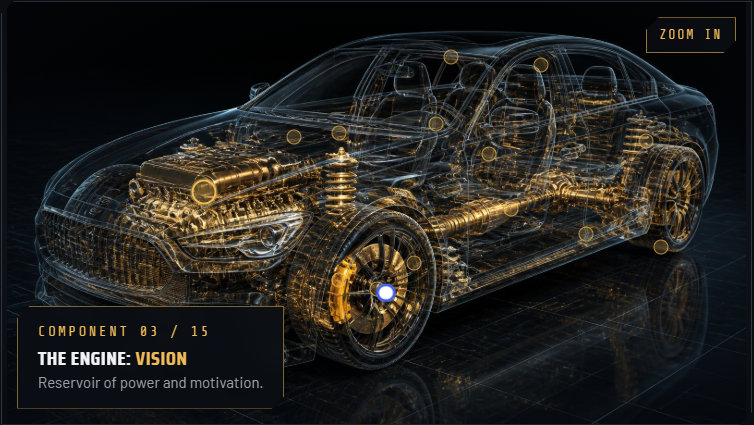
The Genesis of the Recalibration Impact Engineered Framework
The Conversation That Started It
The Recalibration Impact Engineered Framework began with a conversation with my wife about habitats.
As we explored the subject, the word habits entered the discussion. The connection between the two became clear: habits shape our environments, and our environments reinforce our habits.
What we repeatedly do influences where we live, how we spend our time and money, whom we allow into our lives, how we care for ourselves, and what we come to regard as normal. In turn, those surroundings make certain behaviors easier and others more difficult.
Habit shapes habitat. Habitat shapes habit.
As we continued talking, I began to picture a wheel turning. That image led to a more fundamental question:
What makes the wheel turn?
A wheel does not move a vehicle by itself. It is part of a larger system, and its performance depends on the condition and coordination of every other part. That realization became the starting point for RIE.
From Mechanical Systems to Human Performance
My experience working on vehicles taught me to view performance as the result of interconnected systems. An engine, transmission, drivetrain, steering, brakes, suspension, electrical components, fuel systems, safety features, and the driver all contribute to the vehicle’s ability to function.
A powerful engine cannot compensate for bald tires. A full tank of fuel is meaningless without direction. Even a well-maintained vehicle can be difficult to control when the driver lacks awareness or discipline.
In some cases, the vehicle is not broken. It is simply out of alignment.
That observation raised a broader question:
What if human performance operates in much the same way?
Rather than treating the challenges of life as isolated problems, what if we understood them as symptoms of an interconnected system? What if progress depended not only on effort, but also on the alignment of the systems that direct, support, and sustain that effort?
That question became the foundation of the Recalibration Impact Engineered Framework.
Life as an Interconnected System
Many approaches to personal development focus on improving one area at a time: increasing income, improving health, setting goals, developing discipline, strengthening relationships, or pursuing education.
Each of these pursuits can be valuable. However, improvement in one area may be undermined by neglect in another.
Income can increase without corresponding financial discipline. Goals can be established without the habits required to achieve them. Physical strength can improve while mental and emotional health deteriorate. Education can expand knowledge without producing wisdom or application. A compelling vision can exist without the margin necessary to withstand disruption.
The issue is not always a lack of effort.
Often, the issue is a lack of alignment.
RIE begins with the premise that a person’s beliefs, decisions, habits, environment, resources, health, relationships, education, guidance, and capacity for recovery are not separate concerns. They are connected elements of a larger performance system.
Introducing RIE
The Recalibration Impact Engineered Framework, or RIE, applies the logic of engineered performance to human development.
Its central premise is simple:
Your life is a system.
Beliefs influence decisions. Decisions become habits. Habits shape environments, and environments reinforce behavior. Vision establishes direction. Goals translate vision into measurable action. Resources determine sustainability. Health affects capacity. Relationships influence identity and behavior. Education expands capability. Mentors provide perspective. Recovery preserves the ability to continue.
RIE is not merely a method for becoming more successful. It is a framework for understanding how the systems of life work together to shape a person’s performance and impact.
The question is not only, “How do I improve?”
It is also:
“How do the systems of my life need to work together to produce the person, performance, and impact I am capable of creating?”
The Human Performance Vehicle
The vehicle metaphor provides a practical way to understand the framework.
A vehicle requires structure, power, direction, traction, control, protection, maintenance, and a capable driver. Human performance requires the same kinds of support.
Core beliefs provide structure. Vision supplies direction and energy. Goals convert intention into movement. Daily choices determine whether a person remains on course. Habits create traction by translating intentions into consistent behavior.
Boundaries and self-control provide the ability to slow down or stop when necessary. Margin creates capacity to absorb unexpected demands. Resource management determines how long a person can sustain the journey. Physical health supports performance, while mental health and recovery preserve it.
Environment also matters. The conditions in which a person lives and works can either support development or create resistance. Education and experience expand capability, while mentors and coaches provide perspective, correction, and guidance.
These elements are not independent. Their value depends on how well they function together.
A strong vision without healthy habits produces frustration. Ambitious goals without recovery produce burnout. Financial resources without discipline disappear. Education without application remains information rather than transformation. Potential without direction can result in years of movement without meaningful progress.
The objective is not to perfect every individual component. It is to bring the system into greater alignment.
Recalibration Does Not Mean You Are Broken
A vehicle can continue operating while pulling slightly to one side. It may still start, accelerate, and move forward, but the misalignment creates unnecessary stress and eventually causes greater damage.
Human beings can function in much the same way.
A person may continue working, providing, achieving, and meeting responsibilities while operating out of alignment. Priorities may have changed. Habits may no longer support the intended direction. Health may have been neglected. The environment may no longer be suitable. Resources may be stretched too thin. Guidance may be needed.
This condition does not necessarily indicate failure.
Recalibration is the process of recognizing misalignment and making the adjustments necessary to restore direction, stability, and performance.
It is an act of awareness rather than an admission of defeat. It acknowledges that growth, change, and new circumstances require periodic evaluation. A system that once worked well may need to be adjusted as the person, environment, or destination changes.
Recalibration allows a person to move forward with greater intention instead of continuing along a path that gradually creates unnecessary strain.
From Performance to Impact
The purpose of personal development is not simply to become more capable for its own sake.
Growth should produce impact.
Greater strength should create greater capacity to serve. Greater wisdom should benefit families and communities. Financial responsibility should create stability. Leadership development should equip others to lead. Improved health should increase the ability to contribute. Expanded skills should create opportunities that extend beyond the individual.
This is the relationship between recalibration and impact.
RIE is not designed merely to help people build more efficient lives. It is intended to help them steward their abilities, resources, relationships, and opportunities in ways that benefit others.
Performance is valuable because it increases capacity.
Impact is the meaningful use of that capacity.
An Honest Assessment
The vehicle metaphor invites an honest assessment of the systems that shape a person’s life.
Is there a clear vision?
Are current goals aligned with that vision?
Do daily habits create traction or resistance?
Are boundaries protecting what matters?
Is there enough margin to absorb unexpected demands?
Are time, money, energy, and attention being managed responsibly?
Is physical health supporting performance?
Is there sufficient recovery to sustain the journey?
Does the current environment support the person one is becoming?
Is guidance available when perspective is limited?
And perhaps most importantly:
Who is directing the vehicle?
Sometimes the issue is not the system itself, but the decisions being made within it. That recognition is not discouraging. It is empowering. Once the source of misalignment is identified, the process of recalibration can begin.
The Road Ahead
The framework began with a conversation about habitats and habits, followed by an image of a turning wheel and a question about the system behind it.
That question remains central:
What would happen if we intentionally engineered the systems of our lives instead of simply reacting to them?
RIE is not a pursuit of perfection or an attempt to create an impressive appearance. It is a disciplined approach to understanding how life is functioning, identifying what is out of alignment, strengthening what is working, and making the adjustments necessary to move forward.
The goal is not simply to move faster.
The goal is to go farther, go wiser, and create greater impact along the way.
“The plans of the diligent lead surely to advantage…”
Proverbs 21:5
Diagnose. Optimize. Shift into high performance.
Leave a Reply